How to Train a Service Dog: A Practical Step-by-Step Guide
Key Takeaways
Training a service dog in the United States typically takes between 12 and 24 months to complete. Throughout this process, your dog must meet ADA standards for public access, and if you live in Florida, you’ll also need to ensure your team can handle the unique challenges of our climate, crowds, and local environments.
- A service dog is legally defined by the specific tasks it is trained to perform for a person with a disability—not by a vest, registration card, or online certificate.
- Owner training a service dog is permitted under the ADA, but it requires daily commitment to obedience, public manners, and disability-specific task training.
- Not every dog is suited to service work; stable temperament, sound health, and the ability to remain calm around distractions are non-negotiable requirements.
- Professional programs report washout rates around 50%, meaning even purpose-bred puppies may not complete training—this is a normal part of the process, not a failure.
- Readers in Florida seeking professionally trained assistance dogs can contact Genesis Assistance Dogs, Inc. rather than navigating the training process alone.
What Is a Service Dog? (Legal Definition and Real-World Examples)
Under the Americans with Disabilities Act, a service dog is defined as a dog that is individually trained to perform tasks or do work for a person with a disability. This is a working dog, not a pet and not an emotional support dog. The distinction matters because it determines where your dog can legally accompany you and what rights you have as a handler.
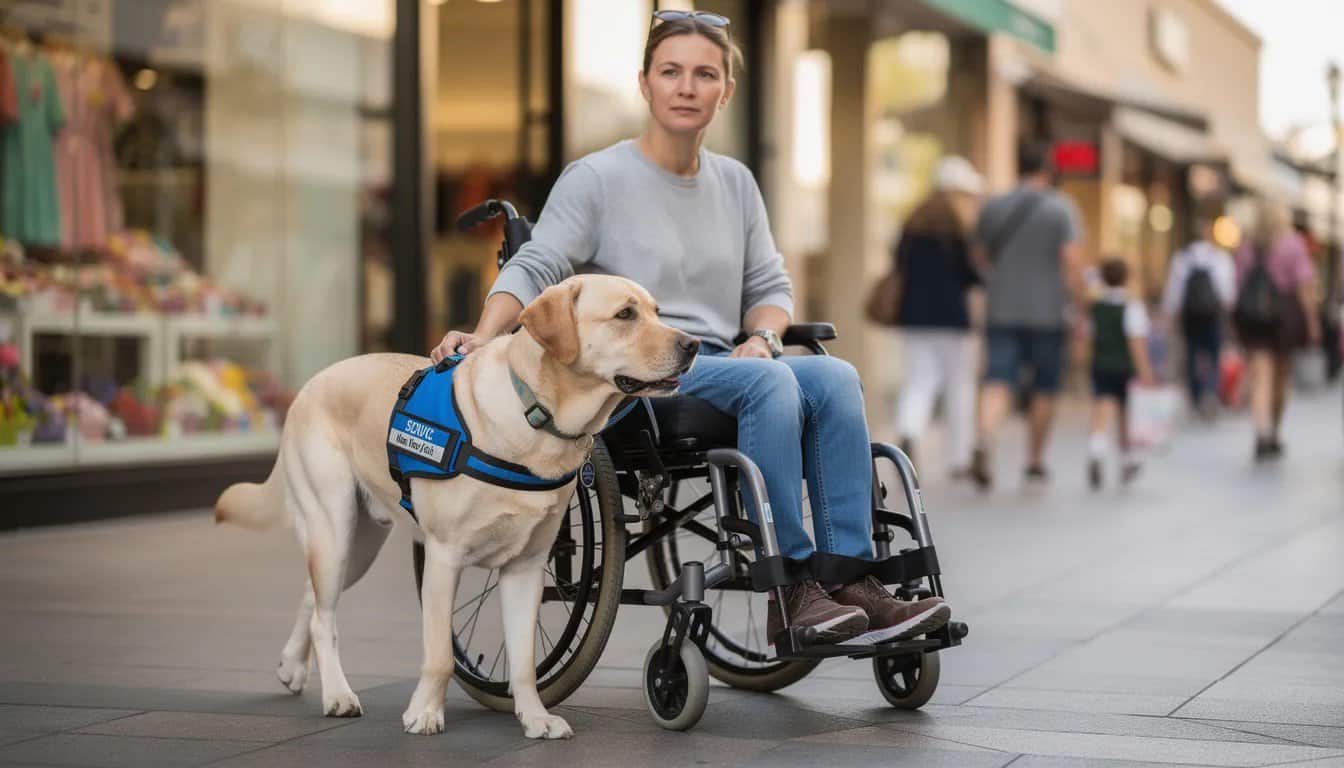
A service animal is required to perform specific tasks that directly relate to the handler’s disability. These tasks can look very different depending on the person’s needs. For example, a guide dog might lead a visually impaired handler safely across a busy intersection in West Palm Beach. A hearing alert dog could notify someone who is deaf when the smoke alarm goes off in their apartment. A psychiatric service dog might interrupt a PTSD flashback in a crowded grocery store by applying deep pressure therapy or nudging the handler to redirect their attention.
Service Dogs vs. Emotional Support Animals vs. Therapy Dogs
The differences between these categories have real consequences for daily life. Here’s how they compare:
| Type | Training Required | Public Access Rights | Legal Protection |
|---|---|---|---|
| Service Dog | Trained to perform specific tasks | Full access to public spaces | ADA (nationwide) |
| Emotional Support Animal | No task training required | Housing only; not the ADA | Fair Housing Act |
| Therapy Dog | Basic obedience and socialization | Facilities by invitation only | None for individual handler |
Emotional support animals provide comfort through their dog’s mere presence, but they don’t perform trained tasks. Therapy dogs visit hospitals and schools as facility dogs but work with their handlers in controlled settings. Only service dogs have the legal right to accompany their handlers into restaurants, stores, and on public transportation.
Qualified disabilities can be physical or mental impairment. This includes conditions like mobility limitations, diabetes, epilepsy, and seizure disorders, as well as psychiatric conditions such as post traumatic stress disorder, severe anxiety, depression, and autism. The key requirement is that the dog must be trained to perform tasks that mitigate the person’s disability.
How Public Access Works in Practice
In Florida, service dogs are allowed in any place open to the public—restaurants, grocery stores, hotels, public transportation, and more. Business staff are legally allowed to ask only two questions:
- Is this a service animal required because of a disability?
- What work or task has the dog been trained to perform?
They cannot ask about the nature of your disability, request documentation, or require your dog to demonstrate the task on the spot.
Is Your Dog a Good Candidate for Service Work?
Not every puppy or adult dog—even one from excellent breeding lines—will tolerate the stress and responsibility of service work. Professional service dog trainers report that approximately 50% of dogs was
h out of formal programs due to temperament or health issues. Owner training carries similar risks, so honest evaluation at the start saves heartbreak later.
Temperament Traits to Look For
A strong service dog candidate typically demonstrates:
- Calm demeanor in busy environments — The dog should remain settled in places like malls, outdoor markets, and busy sidewalks without excessive barking or nervousness.
- Low reactivity to other animals — A dog that lunges, barks, or fixates on other dogs will struggle in public spaces.
- Curiosity without fear — New surfaces like elevators, slick floors, and metal grates should prompt investigation rather than panic.
- Strong focus on the handler — The dog should naturally check in with you and respond to your voice even amid distractions.
- Quick recovery from loud noises — Startling is normal; what matters is how fast the dog bounces back and refocuses.
Health Requirements
Before investing months into training a service dog, confirm that your dog is physically capable of years of work. Essential health checks include:
- Hip and elbow evaluations (especially for larger service dog breeds)
- Clear eyesight and hearing
- Complete veterinary exam with vaccinations appropriate for Florida’s climate and parasites
- No chronic conditions that would limit the dog’s working life
A Basic Candidate Test
Around 4–6 months of age, try walking your dog through a busy environment like a Home Depot garden center. Observe how the dog handles:
- People approaching from different directions
- Shopping cart noises
- Dropped food on the floor
- Sudden loud noises like items falling
A promising candidate will show interest but not fear, recover quickly from surprises, and maintain general focus on you rather than every passing distraction.
Disqualifiers
Some issues are difficult or impossible to train through and should prompt you to consider a different dog:
- History of aggressive behavior toward people or other animals
- Extreme fearfulness that doesn’t improve with positive exposure
- Uncontrollable prey drive that overrides handler’s control
- Chronic medical conditions requiring ongoing intervention
Choosing the Right Breed or Individual Dog
Breed matters less than individual temperament and health, but certain service dog breeds have decades of proven success in different roles. Their consistent traits make training more predictable—though mixed breeds from responsible sources can also excel.
Commonly Successful Breeds
| Breed | Typical Size | Common Roles |
|---|---|---|
| Labrador Retriever | 55–80 lbs | Mobility assistance, medical alert, guide work |
| Golden Retriever | 55–75 lbs | Task work with children, psychiatric support, retrieve objects |
| Standard Poodle | 40–70 lbs | Handlers with allergies, psychiatric tasks |
| German Shepherd | 50–90 lbs | Mobility support, guide dogs, alert work |
Many dogs from these breeds are highly intelligent, eager to work, and maintain focus across different settings. However, even within these breeds, individual variation is significant.
Size Considerations
The tasks your dog will perform should guide your size selection:
- Small dogs (under 30 lbs) work well for hearing alerts, psychiatric interruption tasks, and situations where the handler can’t manage a larger animal
- Medium to large dogs (50–80 lbs) are necessary for mobility assistance like bracing, counterbalance support, or wheelchair pulling
- Opening doors and retrieve objects tasks can work across sizes depending on the specific setup
Evaluating Lineage
Whenever possible, ask breeders about:
- Hip and elbow certifications of parents
- Eye clearances
- Any history of fear, anxiety, or aggression in the line
- Working history of siblings or parents (service work, therapy, or competition)
If adopting a rescue, work with organizations that can provide behavior assessments and medical history.
Owner-Training vs. Professional Training Programs
The ADA allows owner training of service dogs—you don’t need a program or certificate to have a legitimate service dog. However, professional training programs often produce more consistent results because they combine purpose-bred dogs, experienced trainers, and structured curricula.
Owner-Training: What It Really Takes
If you choose to train your own service dog, expect to commit:
- 1–2 hours of focused dog training per day (broken into multiple short sessions)
- Integration of practice into daily errands (grocery runs, restaurant visits, doctor’s appointments)
- 18–24 months minimum before your dog is fully trained for public access and task work
- Ongoing maintenance training throughout the dog’s working life
Owner training builds an exceptionally strong bond between handler and dog. With proper coaching, success rates reach 70–80%. Without guidance, many teams struggle with task training or public access readiness.
Professional Programs: What They Offer
Reputable service dog organization programs provide:
- Carefully selected puppies from proven lines
- Professional trainer expertise in obedience, socialization, and task work
- Structured public access training in diverse environments
- Formal testing before graduation
These programs typically cost $20,000–$30,000 to raise and train each dog, though many non-profits subsidize placement through donations and grants. Wait times of 1–2 years are common due to high demand.
The Hybrid Approach
For many handlers, the best path combines professional guidance with daily owner practice:
- Work with an experienced trainer or organization for weekly coaching sessions
- Handle all daily practice and real-world exposure yourself
- Receive guidance on task training specific to your disability
- Get feedback on public access readiness before working in challenging environments
When to Seek Professional Help
Certain signs indicate your dog needs more expert intervention than basic obedience classes provide:
- Persistent fearfulness in public despite gradual exposure
- Leash reactivity toward people or other animals that isn’t improving
- Inability to settle quietly under a restaurant table or in a waiting room
- Any aggressive behavior toward strangers
Look for trainers with experience in working dogs or service animal training—not just pet obedience. Avoid anyone promising overnight results or using aversive methods that could compromise your dog’s reliability.
In Florida, organizations like Genesis Assistance Dogs, Inc. specialize in fully training and placing assistance dogs for children and adults with disabilities.
Foundation Skills: Obedience, Socialization, and House Manners
Foundation training typically begins around 8–10 weeks of age and continues intensively through the first 18 months. These skills aren’t optional extras—they’re the platform everythi
ng else builds upon. Without solid basic training, advanced training and task work will fail.
Core Obedience Skills
Every service dog must master these commands with near-perfect reliability:
- Name recognition — Immediate attention when you say the dog’s name
- Sit and down — On first cue, in any environment
- Stay — Progressing to 3+ minutes at distances of 20 feet or more
- Loose-leash walking — Walking politely at your side without pulling or weaving
- Reliable recall — Coming when called, even with distractions
- Leave it — Ignoring food, trash, and other temptations on the ground
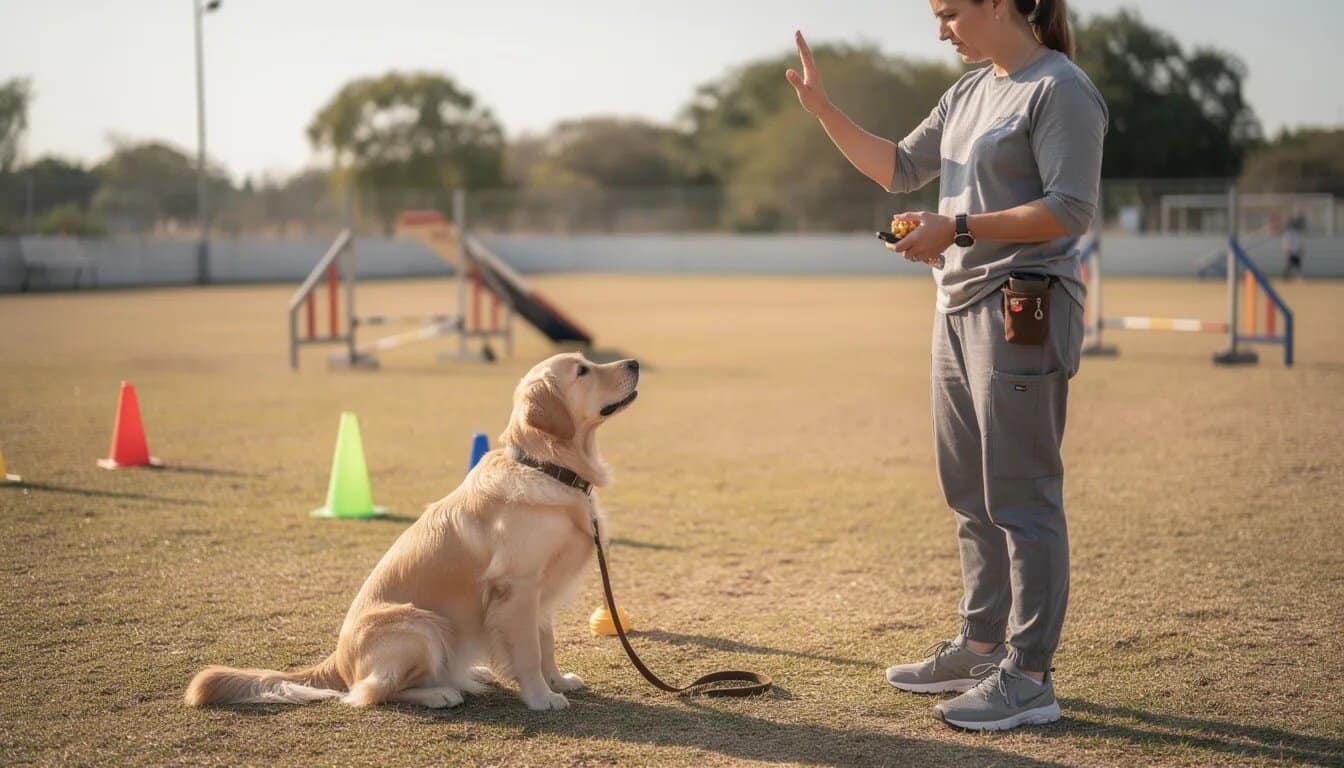
Practice in short sessions of 5–10 minutes multiple times daily. Integrate commands into routines—requiring a sit before meals, a down-stay while you prepare coffee, a recall before going through doors.
Socialization During the Critical Window
The socialization period between 8–16 weeks is your most valuable training opportunity. During this time, positive exposure shapes how your dog will respond to the world for life.
Expose your puppy to:
- People of different ages, sizes, and appearances
- Wheelchairs, walkers, crutches, and mobility scooters
- Children with unpredictable movements and voices
- Crowds at farmers’ markets, outdoor events, and busy sidewalks
- Different surfaces: grass, gravel, tile, metal grates, elevator floors
- Important sounds: traffic, sirens, construction, shopping carts
The goal isn’t just exposure—it’s positive associations. Pair new experiences with treats, praise, and play.
Essential House Manners
Before your dog can handle public spaces, they need reliable behavior at home:
- Settling quietly in a crate without excessive barking or distress
- Greeting guests calmly without jumping
- Ignoring food on counters and tables
- Holding a down-stay on a mat while you work, cook, or eat
Positive Reinforcement Methods
Service dog training relies on positive reinforcement—treats, praise, and play—rather than corrections. Here’s why:
- Dogs trained with aversive methods may develop anxiety that undermines reliability
- Harsh corrections can damage the trust essential to handler-dog partnership
- Positive reinforcement produces dogs that work eagerly rather than fearfully
- Research shows clicker training and shaping build complex behaviors more effectively
Public Access Readiness
By 12–18 months, a public access ready dog should demonstrate:
- Walking politely through grocery store aisles without investigating merchandise
- Riding elevators calmly
- Settling quietly through a 60–90 minute restaurant meal
- Ignoring other animals encountered in public
- Staying focused on the handler despite crowds, noise, and food smells
Prepare for this by practicing in gradually more challenging environments:
- Quiet neighborhood sidewalks
- Pet-friendly stores during slow hours
- Big-box retailers during moderate traffic
- Busy downtown streets and weekend events
The AKC Canine Good Citizen test provides a useful benchmark. If your dog can pass CGC requirements reliably, you’re on track for public access training—though CGC alone doesn’t equal service dog readiness.
Task Training: Teaching Disability-Specific Skills
Task training is what legally qualifies a dog as a service dog rather than a companion animal. The tasks must directly mitigate the handler’s disability—not just provide general comfort or companionship.
Mobility Tasks
For handlers with physical disabilities, trained tasks might include:
- Item retrieval — Picking up dropped keys, phones, credit cards, or medication
- Opening doors — Using a pull strap attached to door handles
- Light switches — Turning lights on and off with paws or nose
- Bracing — Providing steady pressure for balance when rising from chairs
- Wheelchair assistance — Pulling wheelchairs using specialized harnesses
Medical Alert and Response Tasks
Service dogs can be trained to detect and respond to medical events:
- Low blood sugar alerts — Detecting glucose changes and alerting the handler before dangerous levels occur (research shows 90% accuracy in trained dogs)
- Seizure response — Staying with the handler, pressing medical alert buttons, or going to get help
- Medication retrieval — Fetching specific medications from designated locations
- Alerting to important sounds — Smoke alarms, doorbells, or alarm clocks for handlers with hearing loss
Psychiatric and Neurological Tasks
For handlers with mental impairment or psychiatric conditions, psychiatric service dogs can perform:
- Deep pressure therapy — Applying body weight during panic attacks or anxiety attack episodes
- Behavior interruption — Nudging or pawing to stop repetitive behaviors in autism or self-harm
- Reality grounding — Physical contact to interrupt flashbacks or dissociation
- Exit guidance — Leading handler to doors during sensory overload
- Nightmare interruption — Waking handlers from night terrors
Breaking Tasks Into Trainable Steps
Every complex task should be broken into small, achievable steps. For example, teaching a general retrieve might progress:
- Dog touches nose to stationary object on cue
- Dog picks up object held in your hand
- Dog picks up object placed on floor
- Dog picks up object dropped from standing height
- Dog brings object to hand and releases
- Dog retrieves in progressively more distracting environments
This shaping approach prevents frustration and builds reliable behavior through consistent success.
Generalizing Tasks to Real-World Environments
A task performed perfectly in your quiet living room may fall apart in a noisy store or at a crowded beach. Deliberate practice in different settings is essential.
Use real routines to proof tasks:
- Practice phone retrieval every morning at the same time
- Have your dog guide you to a specific exit during weekly grocery runs
- Request deep pressure therapy in various locations—home, car, waiting rooms
Keep training logs to track reliability. Note successes and failures, looking for patterns. A good goal is 8–10 successful performances for every attempt before considering a task “reliable.”
Public Access Etiquette and Legal Responsibilities
Handlers share 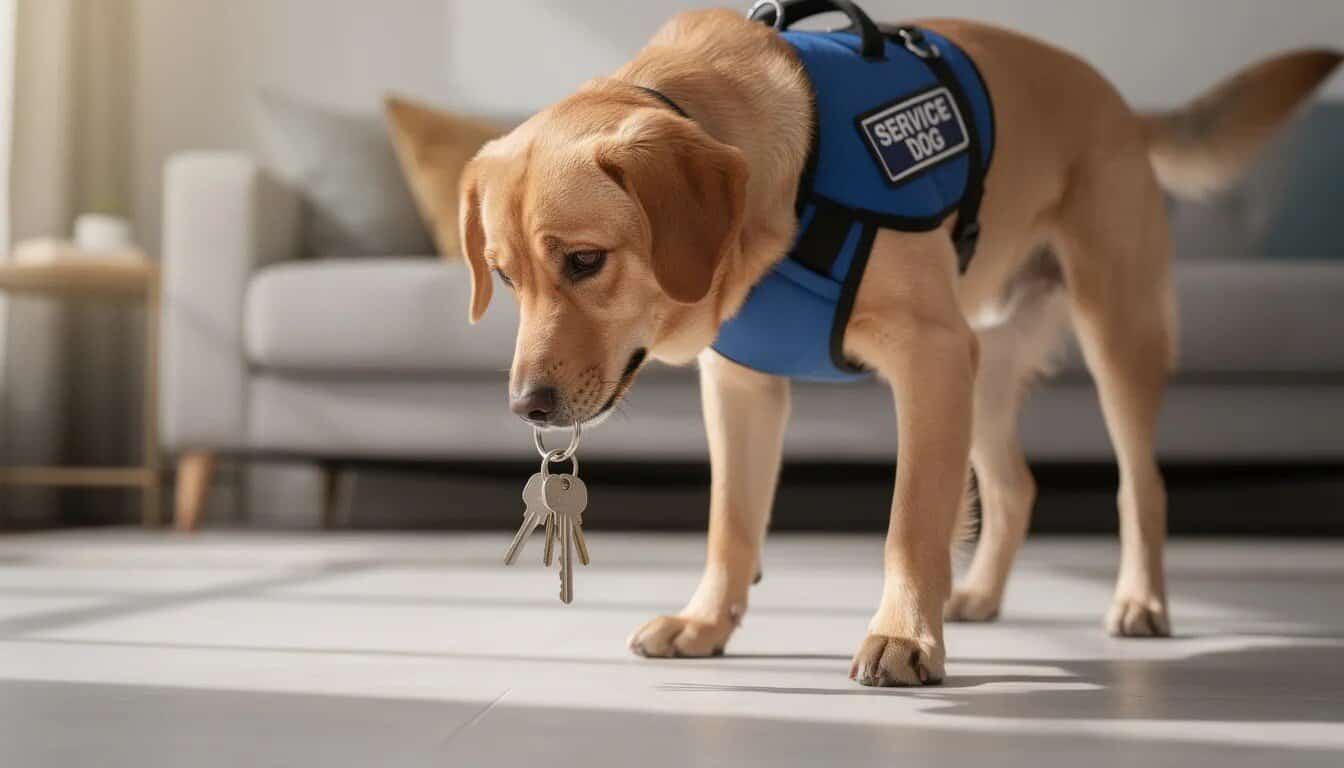 responsibility with their service dogs for maintaining appropriate behavior in public. Poor conduct by one team affects perceptions of all service dog teams and can create barriers for legitimate handlers.
Expected Behavior in Public
Your dog must demonstrate:
- Handler’s control at all times—leash or tether, voice commands, or hand signals
- No barking, lunging, or aggressive behavior
- No sniffing merchandise or people
- No eating from the floor, table surfaces, or other areas
- Settling quietly and unobtrusively when stationary
When Businesses Can Ask You to Leave
Even with a legitimate service dog, businesses can require you to leave if:
- The dog is out of control and you cannot regain control
- The dog is not housebroken
- The dog’s behavior poses a direct threat to health or safety
These rules exist to protect businesses, other customers, and the reputation of working dogs in general.
Handling Public Interactions
Many dogs in public attract attention. Prepare brief, polite responses for common situations:
- Curious strangers: “This is my service dog. He helps me with [general description]. Thanks for asking!”
- Requests to pet: “He’s working right now, so he can’t be petted. Thank you for understanding.”
- Skeptical staff: “He’s a service dog trained to [task]. I’m happy to answer the two questions you’re allowed to ask.”
Florida-Specific Requirements
In addition to federal ADA protections, Florida handlers should:
- Keep current veterinary records including rabies vaccination
- Maintain county licensing as required
- Ensure the dog is healthy enough for Florida’s heat and humidity
- Carry documentation when traveling, even though it’s not legally required
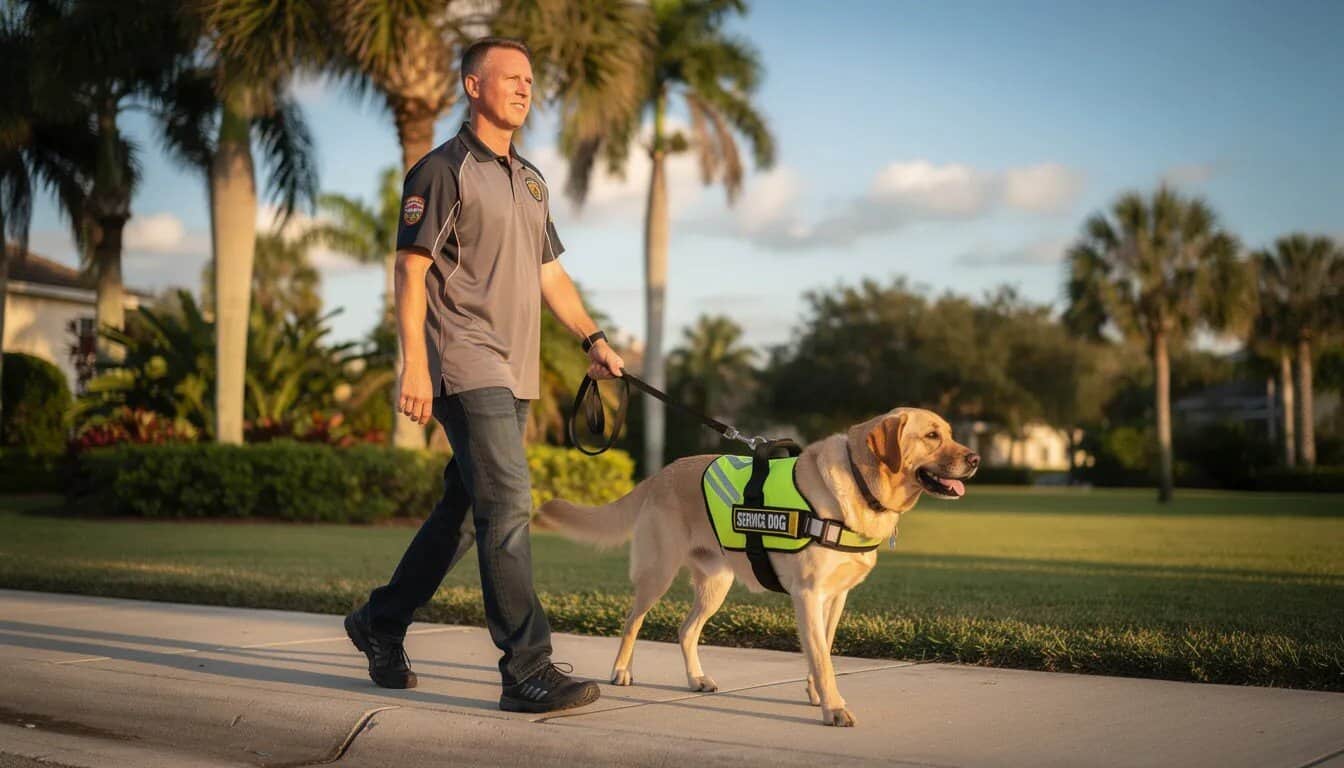
Service dogs are not legally required to wear vests or carry id tags, but many handlers choose visible gear to reduce questions and interference.
How Long Does It Take to Train a Service Dog?
Realistic timelines help set appropriate expectations. Most dogs require 18–24 months from puppyhood to full reliability. Some simpler psychiatric tasks may be ready closer to 12–18 months, while complex mobility assistance often takes the full two years.
Training Phases
| Phase | Age | Focus Areas |
|---|---|---|
| Foundation | 0–6 months | Socialization, house manners, basic obedience |
| Intermediate | 6–12 months | Advanced training, early public access, distraction proofing |
| Advanced | 12–24 months | Complex task training, full public access, real-world proofing |
Ongoing Maintenance
Training doesn’t end when your dog is fully trained. Throughout the dog’s working life:
- Practice task training refreshers weekly
- Address any behavior drift promptly
- Adjust tasks as your needs or abilities change
- Maintain public access skills through regular outings
Washouts Are Normal
Some dogs will wash out at any point in training due to health issues, temperament problems, or tasks that don’t match their abilities. This happens in professional programs and owner training alike.
A washout isn’t a failure—it’s a responsible recognition that the dog isn’t suited to this work. Many dogs that can’t complete service training make excellent companion animals or therapy dogs.
The Value of Patience
Shortcuts in service dog training create unreliable teams that may be denied access, create safety risks, or fail when you need them most.
The goal is long-term independence and safety. Every week of consistent practice builds toward a partnership that will serve you for 8–10 years of your dog’s working life.
About Genesis Assistance Dogs, Inc.
Genesis Assistance Dogs, Inc. is a Florida-based non-profit dedicated to empowering children and adults with disabilities through highly trained assistance dogs. Founded on the belief that canine companions can transform lives, Genesis provides carefully selected, trained, and placed dogs at no cost to qualified handlers.
Our Mission
The mission of Genesis Assistance Dogs Inc. is to provide ability and independence to transform the lives of people with disabilities, through the training and placement of highly skilled assistance dogs in Florida for children and adults.
Our Vision
People with disabilities can realize their full potential through the dedication, service, and companionship of a highly skilled assistance dog. Whether the need is mobility assistance, medical alert, or psychiatric support, the right canine partner opens doors to independence that might otherwise remain closed.
What We Provide
Genesis Assistance Dogs, Inc. carefully:
- Selects puppies and dogs with the temperament and health for service work
- Raises and socializes dogs in Florida environments and com

- munities
- Trains each dog for public access, home life, and disability-specific tasks
- Matches dogs with handlers based on lifestyle, disability, and compatibility
- Provides follow-up support throughout the working partner
- ship
Get in Touch
If you live in Florida and are interested in receiving an assistance dog, volunteering, or supporting our mission through donation, we’d love to hear from you.
Phone: (561) 329-0277 Email: info@genesisassistancedogsinc.org
FAQ: How to Train a Service Dog
At what age can my dog start service dog training?
Early socialization should begin at 8–16 weeks, exposing your puppy to people, places, sounds, and surfaces. Serious task training typically starts after 6–8 months when the dog’s attention span and physical coordination have developed enough for more complex work. Foundation obedience work can begin as soon as you bring your puppy home.
Do I legally have to put a vest on my service dog?
No. The ADA does not require vests, harnesses, id tags, or any form of identification for service dogs. However, many handlers choose to use visible gear because it reduces public interference, minimizes questions from business staff, and signals that the dog is working rather than available for petting.
Can my service dog go with me to college or my job?
Yes. Under the ADA, service dogs are allowed in workplaces and educational institutions. The Fair Housing Act also requires colleges and employers to allow service dogs in campus housing and work environments. You may need to coordinate with disability services offices or HR departments, but your access rights are protected by federal law.
If I train my service dog in Florida, will it be recognized in other states?
Absolutely. The ADA is federal law, which means your service dog rights follow you across all state lines within the United States. Air travel is governed by Department of Transportation regulations, which also recognize trained service dogs. When traveling internationally, you’ll need to research each country’s specific requirements.
What happens if my dog doesn’t complete service dog training?
Dogs that wash out of service training often make wonderful pets or may be suited for less demanding roles as therapy dogs or emotional support animals. A washout reflects a mismatch between the dog’s abilities and service work demands—not a personal failure. Professional programs experience roughly 50% washout rates, so this outcome is completely normal and part of responsible training.