Service Dog Training: Task Training and Obedience Standards
Quick Summary: Obedience cues build control, but under the ADA, a service dog must also perform individually trained tasks that directly reduce a handler’s disability-related limitations. Good task training starts with proofed cues, breaks behaviors into small steps, and adapts them to the handler’s real routine, such as fetching medication in a dim hallway at 2 a.m. There is no federal certification or public access test, though groups like ADI and IAADP provide industry evaluations and training benchmarks that can help assess readiness. Genesis Assistance Dogs follows this approach by emphasizing client-specific task work and handler placement.
A dog can sit, stay, and heel flawlessly and still not qualify as a service animal. Under the ADA, what counts is individually trained work or tasks that directly relate to a person’s disability. That’s the gap many handlers stumble over. This guide connects obedience training benchmarks to real task training, separates federal law from industry standards like IAADP’s 120-hour guideline, and shows what to ask any program, including ours in Florida, before you commit.
Command vs Task: What the ADA Actually Requires
The Difference Between a Command and a Task
A command is a cue the dog already knows, like “sit” or “heel.” A task is an individually trained behavior that lessens the effect of a handler’s disability, such as bracing during a fall or alerting to low blood sugar. The ADA protects dogs because of trained tasks, not obedience alone.
- Command: general obedience cue
- Task: disability-specific trained work
What Counts as a Task, and What Does Not
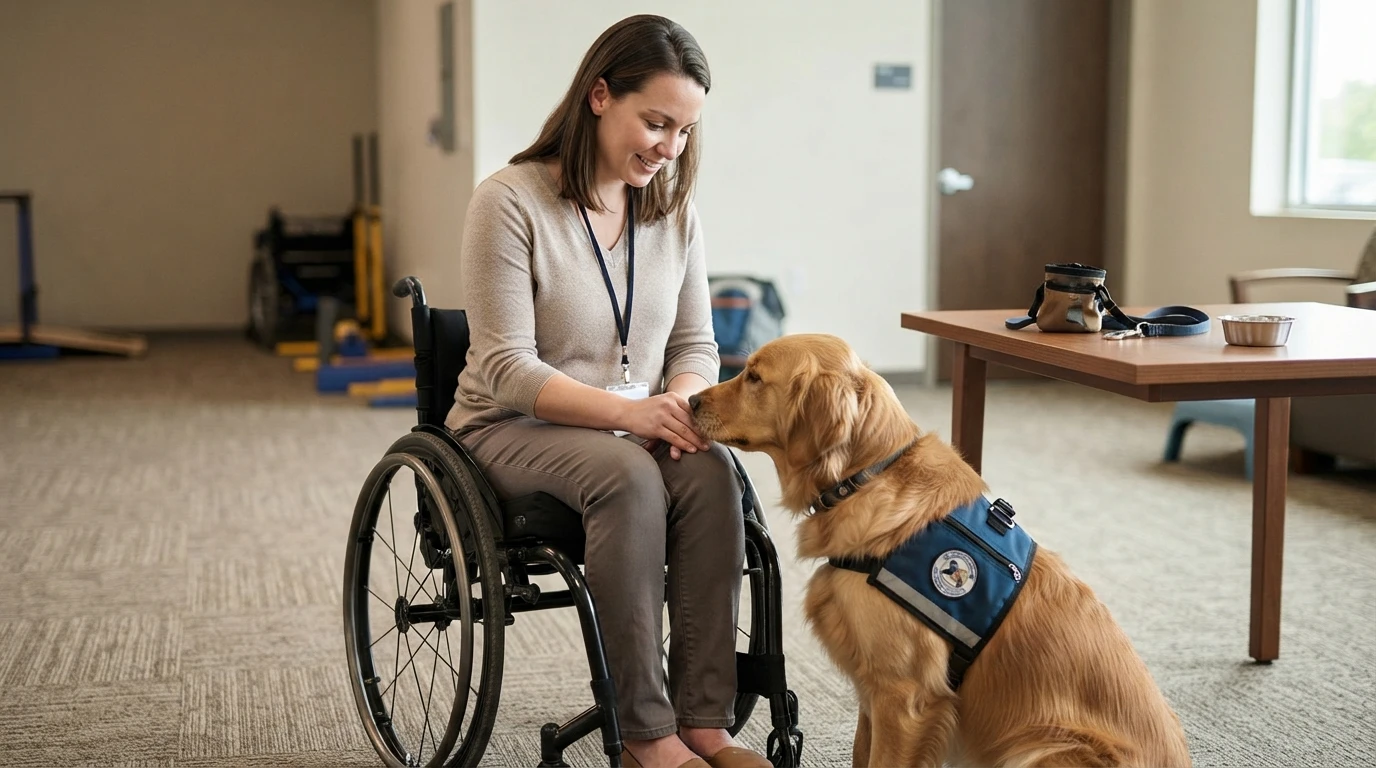
The law counts work performed for a person with a disability: deep pressure therapy, medical alerts, retrieving items, or interrupting a panic attack. Good manners, trick cues, and emotional comfort by presence do not qualify. Providers that plan service dog task training around each client’s needs help teams meet that bar.
Core Obedience Cues Every Service Dog Needs
The Foundation Cue Set and Why It Comes First
Every service dog works from the same core set:
- Sit and down – steady positions on cue
- Stay – holding position until released
- Come – a reliable recall, including off-leash
- Heel – walking calmly at your side
- Leave it – ignoring food, people, and objects
- Place or settle – going to a mat and lying quietly
These cues build the focus and control that task training depends on. Programs like Genesis Assistance Dogs drill this foundation first, because weak obedience shows up later as missed tasks.
Proofing Obedience Around Distractions
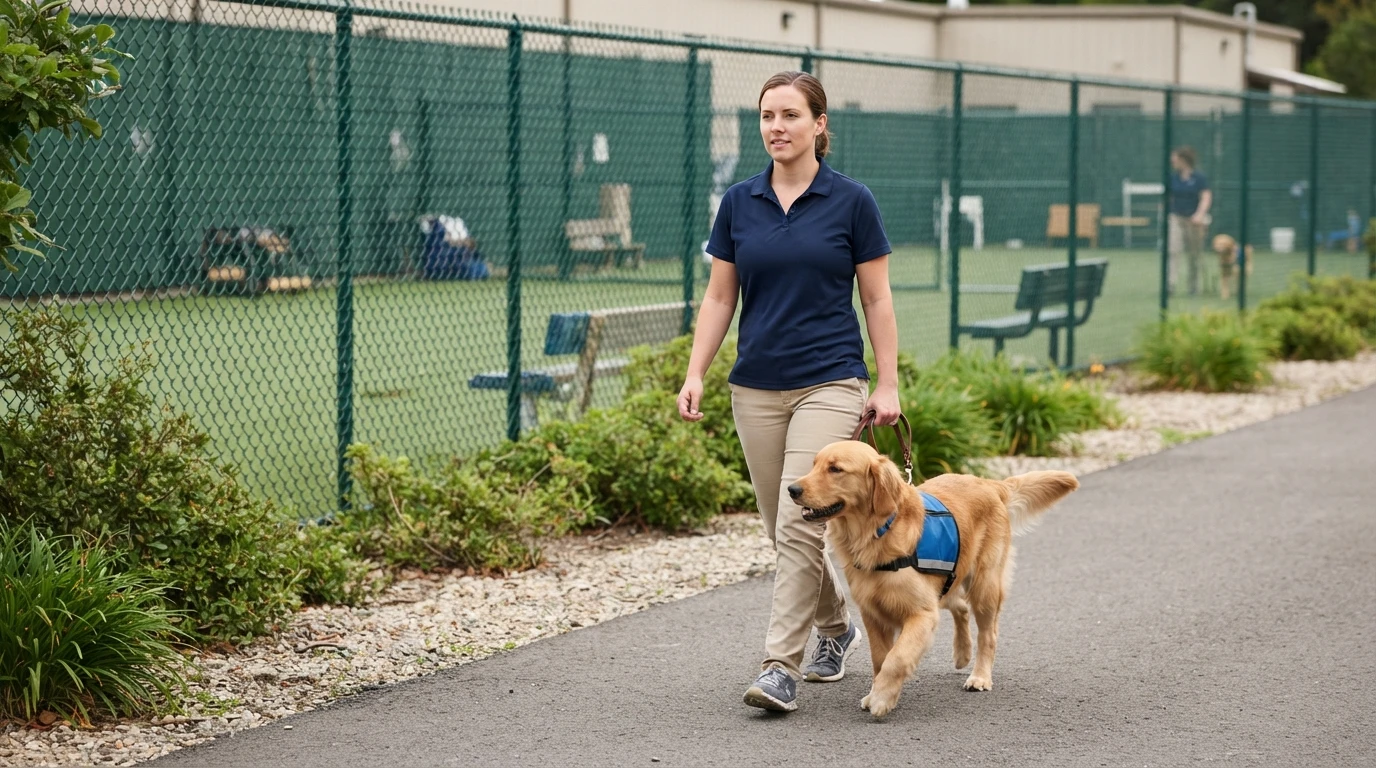
A cue your dog follows at home is not a public-ready cue. Proofing means practicing each command around crowds, food, other dogs, and sudden noise until the response holds anywhere. Add one distraction at a time, reward correct choices, and keep sessions short. Drop difficulty back down when the dog starts guessing.
Public Access Testing: What the Evaluation Actually Measures
Legal Right of Access Versus Industry Evaluation
The ADA grants access rights but requires no test or certification, so no federal agency administers a public access exam. Industry groups fill that gap: Assistance Dogs International publishes a formal evaluation, and IAADP’s minimum training standards include a documented 120-hour benchmark. Passing proves readiness, not legal status.
What the Evaluation Scores
The ADI public access test scores a team on:
- Calm, controlled walking through crowds
- Ignoring food, distractions, and strangers
- Settling quietly under a table
- Polite response to strangers and the ADA’s two questions
- Safe, controlled vehicle loading
- Reliable obedience on and off leash
The goal is a dog that stays stable and unobtrusive anywhere. Programs train and match handlers with this standard in mind before placement.
How Task Training Is Actually Taught
Marker, Target, and Back-Chaining
Trainers break each task into small steps and mark correct behavior with a clicker or a word like “yes,” followed by a treat. Targets teach the dog to touch or follow an object. Back-chaining builds the final sequence first, so the last step becomes the strongest. This is the core of modern service dog training.
Matching Tasks to a Handler’s Real Routine
A task only counts if it helps the handler daily. Trainers watch the person’s schedule, mobility limits, and home layout, then shape behaviors around them. A dog trained to fetch medication on command still needs to do it at 2 a.m. in a dim hallway, so real-life proofing comes before polish.
If you’re training a service dog or wondering whether yours is ready, Genesis Assistance Dogs can help. Learn about our Florida training and placement programs at Genesis Assistance Dogs.
Frequently Asked Questions
Q1: What is the difference between a command and a task in service dog training?
A command is a known obedience cue like “sit.” A task is individually trained work that lessens your disability, such as medical alerts. Only tasks count under the ADA.
Q2: What are the core obedience cues every service dog needs?
Sit, down, stay, come, heel, leave it, and place or settle. Proof each one around crowds, food, and noise before starting task work.
Q3: What does the Public Access Test evaluate for service dogs?
It scores calm walking in crowds, ignoring food and strangers, settling under tables, vehicle loading, and reliable obedience on and off leash.
Conclusion
Service dog training rests on one distinction: obedience cues build control, but only individually trained tasks tied to your disability count under the ADA. Proof every cue in public, meet industry benchmarks like the 120-hour guideline and the ADI public access test, then shape tasks around your real routine. Solid service dog training pairs that foundation with task work matched to the handler, which is how teams stay reliable anywhere.