What Questions Can You Ask About a Service Dog?
What Questions Can You Ask About a Service Dog?
Key Takeaways
- Under the Americans with Disabilities Act, staff and business owners may only ask two specific questions about a service dog when the disability and task are not obvious.
- It is never legal to ask for details about the handler’s disability, request medical records, or demand certification papers or an id tag for a service animal.
- Service dogs, emotional support animals, and therapy dogs are treated differently under federal law—only service dogs have full public accommodation rights.
- Polite, neutral scripts help employees confirm access without making handlers feel interrogated or singled out.
- Genesis Assistance Dogs, Inc. trains and places highly skilled assistance dogs for people with disabilities throughout Florida.
Introduction: Why Knowing the Right Questions Matters
Service dogs have become increasingly visible in Florida and across the U.S. since about 2010. You’ve probably noticed them in grocery stores, airports, lecture halls, and even beachfront cafés. Yet despite their growing presence, many people still feel unsure about what questions can you ask about a service dog without crossing legal or ethical lines.
The confusion is understandable. You want to respect both the law and the handler’s privacy, but you genuinely don’t know the permissible questions. This article focuses on U.S. law—especially the Americans with Disabilities Act—and is written for business owners, staff, landlords, and everyday community members who encounter service animals in public places.
Our goal is simple: give you clear, human, real-world guidance so you can handle situations involving service dogs with confidence and empathy.
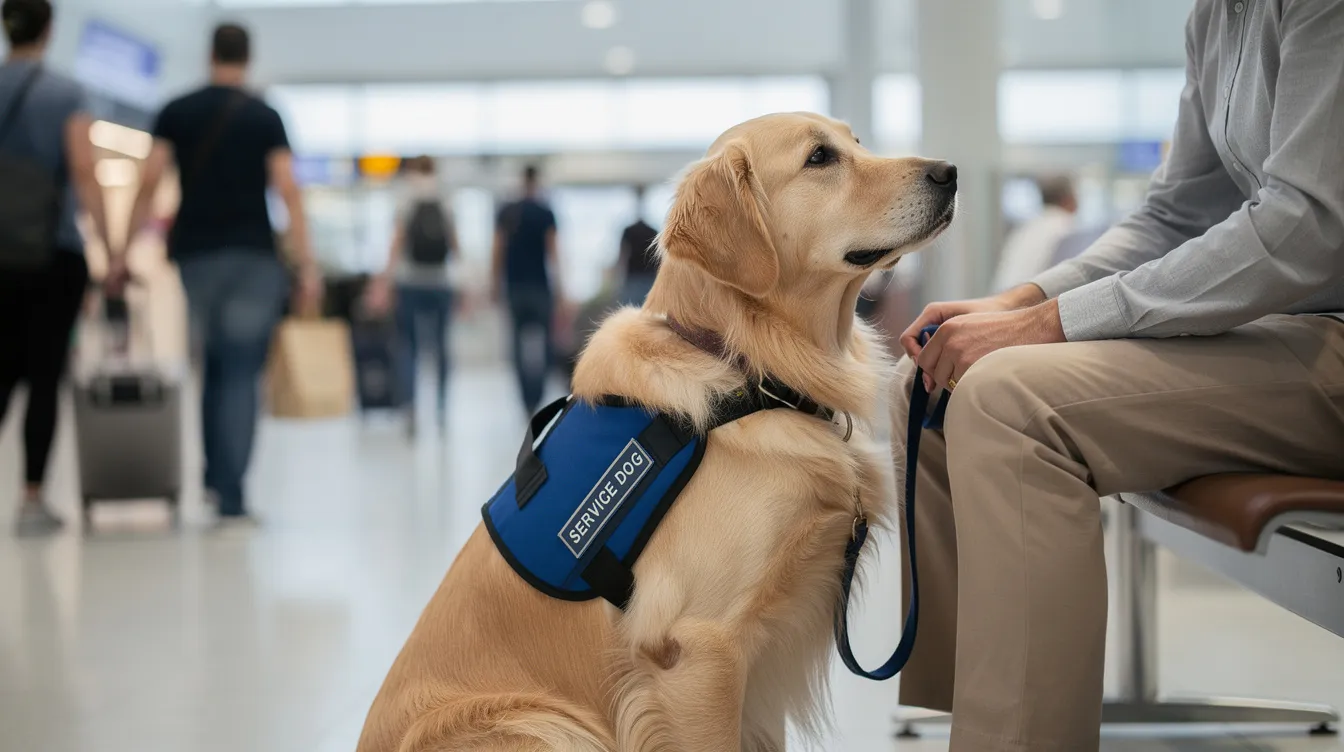
What Questions Can You Legally Ask About a Service Dog?
Under the ADA, when it is not obvious that a dog is a service animal required because of a disability, staff may ask only two specific questions:
- “Is the dog a service animal required because of a disability?”
- “What work or task has the dog been trained to perform?”
That’s it. These are the only permissible questions allowed in most instances across restaurants, retail stores, medical offices, hotels, and libraries.
If the service animal’s work is apparent—say, a dog is clearly guiding a person who is blind or providing balance support for someone using a walker—staff should not ask these questions at all. The need is already obvious.
These rules come directly from the U.S. Department of Justice, which issued key clarifications in 2010 and subsequent fact sheets. The framework exists to protect handler privacy while giving covered entities a legitimate way to confirm access rights.
What You Cannot Ask or Require About a Service Dog
The handler’s privacy is protected under federal law. Overstepping these boundaries can lead to discrimination complaints or legal liability, with documented settlements averaging $10,000 to $75,000 in cases from 2010 through 2025.
Here’s what you cannot do:
- Ask about the nature, severity, or details of the person’s disability
- Request medical documentation, a doctor’s note, or proof of the disability
- Require special certification papers, registration documents, or an id tag
- Demand that the dog demonstrate its task on command (no “prove it” requests)
- Ask the handler to show a vest, harness, or any specific equipment
- Charge extra pet fees, security deposits, or cleaning fees for the service animal (except for actual damage caused)
Online “service animal registries” carry no legal weight under the ADA. The Department of Justice has explicitly stated these may even signal fraud. A particular service animal needs no papers—only training and a task directly related to the person’s disability.
How to Ask About a Service Dog Politely (With Example Scripts)
Feeling awkward about what to say is normal. The key is staying calm, neutral, and policy-focused rather than skeptical or accusatory.
Sample Scripts for Different Settings
Busy café line (2026 Palm Beach County):
“Hi there—if you don’t mind my asking, is your dog a service animal for a disability, and what task is it trained to perform?”
Small boutique with limited space:
“I just need to follow our ADA policy. Is this a service dog, and what work does it do for you?”
Hotel front desk during check-in:
“We’re happy to accommodate service animals. May I ask if the dog is required because of a disability and what task it’s been trained to perform?”
Tone Tips
- Speak directly to the handler, not the dog
- Keep your voice neutral and friendly
- Avoid skeptical wording like “Is that really a service dog?”
- Pull the person aside if possible—don’t raise the topic in front of a crowd
- Remember: the goal is to confirm access, not to challenge or interrogate

Understanding the Difference: Service Dogs vs. Emotional Support Animals
A service dog is an individually trained animal that performs specific tasks directly related to a person’s disability. Examples include:
- Guiding a person who is blind through unfamiliar spaces
- Alerting a person with diabetes to blood sugar changes
- Interrupting an anxiety attack for someone with PTSD
- Helping a returning veteran navigate crowds by creating physical space
Emotional support animals and therapy dogs, by contrast, provide comfort but are not typically trained to perform tasks tied to a specific disability. Under the ADA, only dogs (and in limited cases, miniature horses) qualify as service animals for public accommodation purposes.
| Type | Trained Tasks? | Public Access Under ADA? |
|---|---|---|
| Service Dog | Yes, specific tasks | Yes |
| Emotional Support Animals | No | No |
| Therapy Dogs | No (work for others’ benefit) | No |
The Fair Housing Act and U.S. Department of Transportation rules may treat assistance animals differently for housing and air travel. But in most public places—restaurants, stores, gyms—emotional support animals do not have the same protections as service animals.
Never ask, “Is that just an emotional support dog?” Instead, rely on the two ADA-approved questions about disability-related work.
When Can a Service Dog Be Asked to Leave?
Even a legitimate service animal can be excluded if it poses a direct threat or fundamentally alter the nature of a business. The criteria focus on behavior, not breed or appearance.
Valid reasons to remove a service dog:
- The dog barks repeatedly or lunges aggressively
- The service animal behaves in ways that are out of the owner’s control despite warnings
- The dog is not housebroken
- The animal poses legitimate safety requirements concerns (e.g., direct threat to other guests)
Invalid reasons for removal:
- Other customers are afraid of dogs
- Someone has mild allergies
- The business is not “pet friendly”
How to Handle Removal
- First, politely ask the handler to maintain control of the dog
- If problems continue, request the dog be taken outside
- Still serve the person with a disability—offer to complete their transaction or provide other effective means of service without the animal present
Narrow exceptions exist for sterile environments like operating rooms or certain food prep areas where health codes apply. But these are rare and must be based on legitimate safety requirements, not convenience.
Rights and Responsibilities of Handlers and Businesses
Both sides carry responsibilities. Handlers must control and care for their service dogs; businesses must provide equal access without segregation or extra fees.
Handler Responsibilities
- Feeding, grooming, and toileting the dog
- Veterinary care and vaccinations
- Keeping the dog under control via leash, harness, or voice commands
- Ensuring the dog is housebroken and well-behaved
Business Responsibilities
- Allowing service animals in all areas where customers typically go
- Not charging pet deposits or cleaning fees for service animals
- Not segregating handlers to “pet-friendly” sections
- Training staff on ADA requires and state and local laws
ADA requires businesses to modify policies to accommodate service animals. A retractable leash or voice control is acceptable if the person’s disability prevents using a standard leash.
Businesses in Florida should develop a short written service dog policy and train all staff—including seasonal hires—to reduce misunderstandings and potential liability.
How These Rules Apply in Florida and Everyday Situations
While the ADA is federal law, state laws like Florida’s F.S. 413.08 may provide additional protections. Florida also penalizes service animal misrepresentation with fines up to $500.
Real-World Florida Scenarios
Palm Beach County café: A staff member notices a dog under a table. The task isn’t obvious, so they quietly approach and ask the two questions. The handler explains the dog alerts to seizures. Access confirmed—no further inquiry needed.
Theme park ride queue: A guest has a dog wearing a vest. Staff ask the two questions near a quiet place away from the line. The handler describes mobility assistance tasks. The dog is admitted unless the ride has legitimate safety requirements that devices interfere with.
Condominium pool deck: A resident brings a service dog poolside. HOA staff may ask the two questions but cannot exclude the dog based on other guests’ allergies or fears. If the dog bark repeatedly or shows aggression, removal is appropriate—but serve food to the handler in another area if possible.
Florida grants public access rights to service dogs in training, unlike federal ADA. Businesses should check local laws and consult legal resources for guidance.

About Genesis Assistance Dogs, Inc.
We are Genesis Assistance Dogs, Inc., a nonprofit organization based in Florida dedicated to training and placing highly skilled assistance dogs for people with disabilities.
Our Mission: To provide ability and independence that transforms the lives of children and adults with disabilities through professionally trained assistance dogs.
Our dogs undergo 12 to 18 months of training to perform tasks like:
- Retrieve items dropped on the floor
- Open and close doors
- Provide balance support
- Alert to medical events
Our Vision: For people with disabilities to realize their full potential through the dedication, service, and companionship of a well-matched assistance dog.
We place 20 to 30 dogs annually with Florida families, carefully matching each team for long-term success.
Ready to learn more?
- Phone: (561) 329-0277
- Email: info@genesisassistancedogsinc.org
Whether you’re interested in applying for an assistance dog, volunteering, or supporting our work, we’d love to hear from you.
FAQ: Common Questions About Service Dogs and What You Can Ask
Can I ask a service dog handler to show certification or an ID card?
No. Under the ADA, businesses and staff cannot require certification papers, registration documents, or ID cards as a condition for entry. Self-training is permitted—handlers or their families can train dogs without professional programs. Those online “registries” selling certificates for $20 to $100 hold no legal weight and may indicate fraud.
What if my business has a strict “no pets” policy?
Federal law requires reasonable accommodation through modification of “no pets” rules to allow service animals. Service dogs are not legally considered pets. Your policy must adapt to permit access while still applying behavior-based removal criteria if problems arise.
How should I handle another customer’s allergy or fear of dogs?
Fear of dogs or common allergies are not valid reasons to deny access to a person with a service animal. Practical accommodations include seating people in different areas or scheduling appointments at different times. The service animal handler’s rights generally take precedence under the ADA.
Are staff allowed to pet or talk to a service dog?
Staff should not touch, feed, or distract a service dog without the handler’s explicit permission. Interruptions can interfere with the service animal’s work—potentially missing a medical alert or causing the handler great difficulty. Always ask before interacting.
Do the same protections apply to service dogs in training?
The ADA does not require public access for service dogs in training. However, Florida state law grants specific rights for training dogs in public places. Businesses should check local laws or consult legal resources to understand their obligations beyond federal requirements.