Veterans Training Service Dogs: How Shared Training Transforms Lives
Key Takeaways
- Veterans training service dogs can reduce PTSD symptoms by 30-40%, lower suicide risk, and decrease medication reliance, according to program outcomes tracked since 2010 across the United States.
- Many programs intentionally use rescue dogs, giving both the dog and the veteran a second chance at a meaningful life together.
- Structured training programs (typically 4-6 months) build trust, teamwork, and confidence for veterans living with PTSD, TBI, and military sexual trauma.
- The hands-on training process itself is therapeutic, providing veterans with purpose, routine, and the powerful bond that comes from teaching and leading their own service dog.
- Genesis Assistance Dogs, Inc. in Florida helps children and adults with disabilities through highly trained service dogs. Contact details and eligibility information are provided at the end of this article.
Healing at Both Ends of the Leash
Since roughly 2011, something remarkable has shifted in how America supports its veterans. Instead of simply placing fully trained service dogs with those who need them, a growing number of programs now invite veterans with PTSD and traumatic brain injury to do much of the training themselves. The idea is simple but profound: when a veteran teaches a dog to heel, to interrupt a nightmare, or to create space in a crowded room, both of them are learning. Both of them are healing.
This is what practitioners call “healing at both ends of the leash.” The veteran gains structure, purpose, and a reason to get out of bed. The dog, often a rescue from a shelter facing uncertain odds, gains a mission and a human who needs them. Together, they form a team that neither could have become alone.
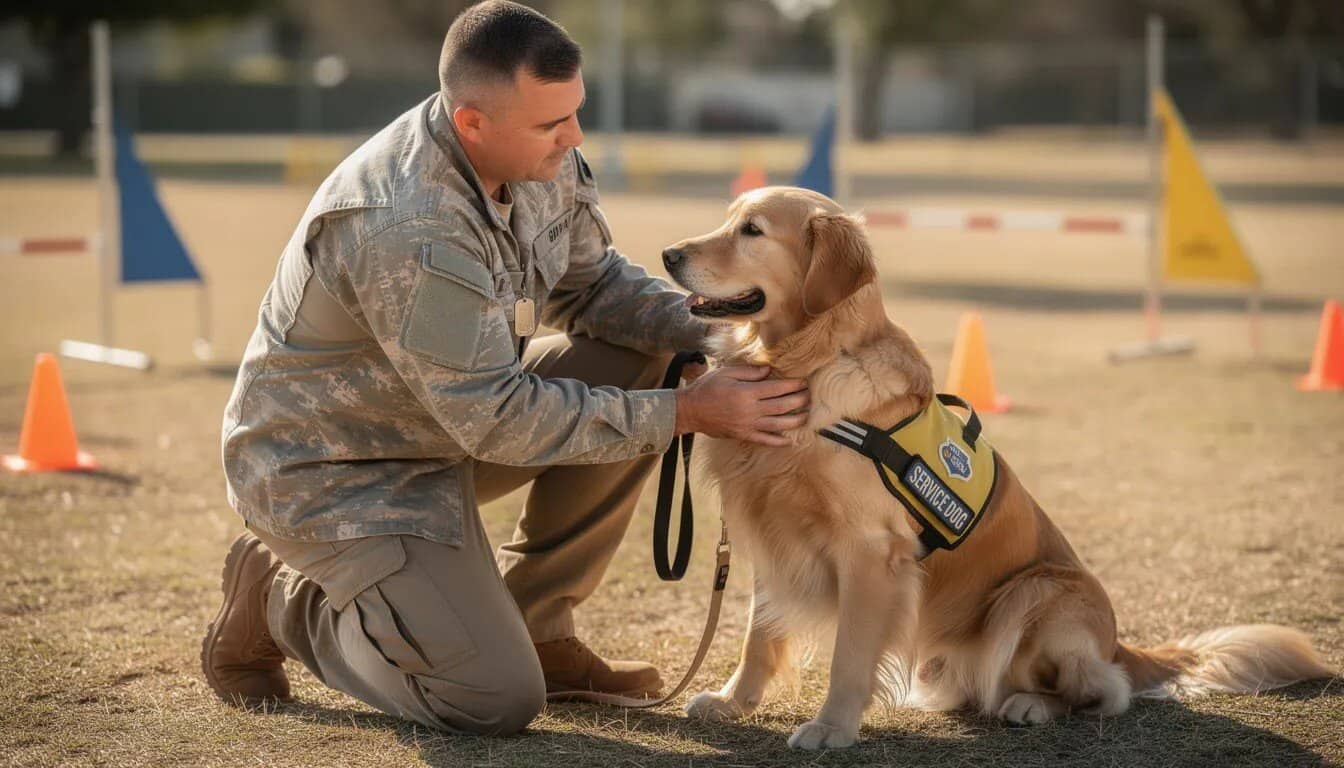
Veterans who participate in these programs often report fewer nightmares, reduced hypervigilance, and a renewed ability to do things that once felt impossible: grocery shopping, attending a child’s school event, or sitting through a family dinner without scanning for exits. For those living with invisible wounds like PTSD and military sexual trauma, service dog training offers something different from medication or traditional therapy. It offers a dignified, strengths-based path forward, where the veteran is the teacher, not just the patient.
A Battle Worth Fighting: Why Veterans Need Service Dogs
Data widely cited since the early 2010s tells us that roughly 20 to 22 U.S. veterans die by suicide every day. That number alone demands new tools, new approaches, and new forms of support for those who served this country.
Veterans live with chronic symptoms that don’t disappear when military service ends. Post traumatic stress disorder brings panic attacks, flashbacks, and a nervous system stuck on high alert. Traumatic brain injury can cause memory gaps, confusion, and difficulty with balance. Military sexual trauma leaves survivors struggling with trust, isolation, and anxiety in public spaces. Depression, insomnia, anger, and withdrawal become daily companions for far too many.
A properly trained service dog can make a measurable difference in daily life. These dogs learn to interrupt panic attacks by nudging or licking, wake veterans from night terrors before they escalate, create physical buffers in crowded areas to reduce hypervigilance, and lead their handlers to exits when anxiety spikes. For veterans who once avoided public spaces entirely, a service dog becomes a bridge back into the world.
Research published after 2015 in Florida and other states, along with data from nonprofit programs nationwide, shows reduced suicidal thoughts and improved quality of life when veterans have trained service dogs by their side. The VA has tracked outcomes showing that service dog veterans use 50% fewer opioids and report 40% reductions in anxiety.
Consider a veteran like John, a former U.S. Army sergeant who struggled for years after two deployments to Afghanistan. After beginning service dog training in 2022, he was able to reduce his medication under his doctor’s guidance and, for the first time in years, attended his daughter’s graduation without leaving early. That moment, sitting in the bleachers with his dog’s head on his knee, felt like reclaiming a piece of his life he thought was gone forever.
How Veterans Train Service Dogs: A Unique Approach
When people hear “veterans training service dogs,” they sometimes picture a veteran simply receiving a finished, fully trained dog. The reality is much more hands-on and much more powerful.
In these programs, veterans participate directly in the training process. They’re matched with carefully temperament-tested dogs, often between one and three years old, and then work together several times per week under the guidance of professional trainers. The veteran becomes the primary handler, learning to read their dog’s body language and building skills from the ground up.
Training covers three main areas:
| Skill Category | Examples |
|---|---|
| Basic Obedience | Sit, stay, heel, down, come, loose-leash walking |
| Task Training | Nightmare interruption, deep pressure therapy, retrieving medication, turning on lights, grounding during flashbacks |
| Public Access | Riding elevators, restaurant manners, crowded sidewalks, medical office behavior |
This approach stands in contrast to traditional models where dogs arrive already trained. Here, the journey itself is the therapy. Teaching a dog to respond to a panic attack means the veteran must understand their own triggers. Leading a dog through a busy store means the veteran must leave the house and practice, week after week.
The structure matters too. Scheduled training sessions, homework practice at home, and regular check-ins with trainers and peer veterans create a rhythm that many veterans have missed since leaving the military. It’s a form of service after military service, a mission that makes sense.
Six-Month Service Dog Training Journey
Many veteran-focused programs use a structured timeline of about four to six months. Here’s what a typical six-month progression might look like:
Month 1-2: Foundation and Bonding
The first weeks focus on building trust between veteran and dog. Training takes place in controlled environments, emphasizing basic obedience, leash work, and learning to communicate. The veteran practices reading their dog’s signals, and the dog learns to look to the veteran for guidance. This phase is about creating a foundation strong enough to support everything that follows.
Month 3-4: Public Access and Task Introduction
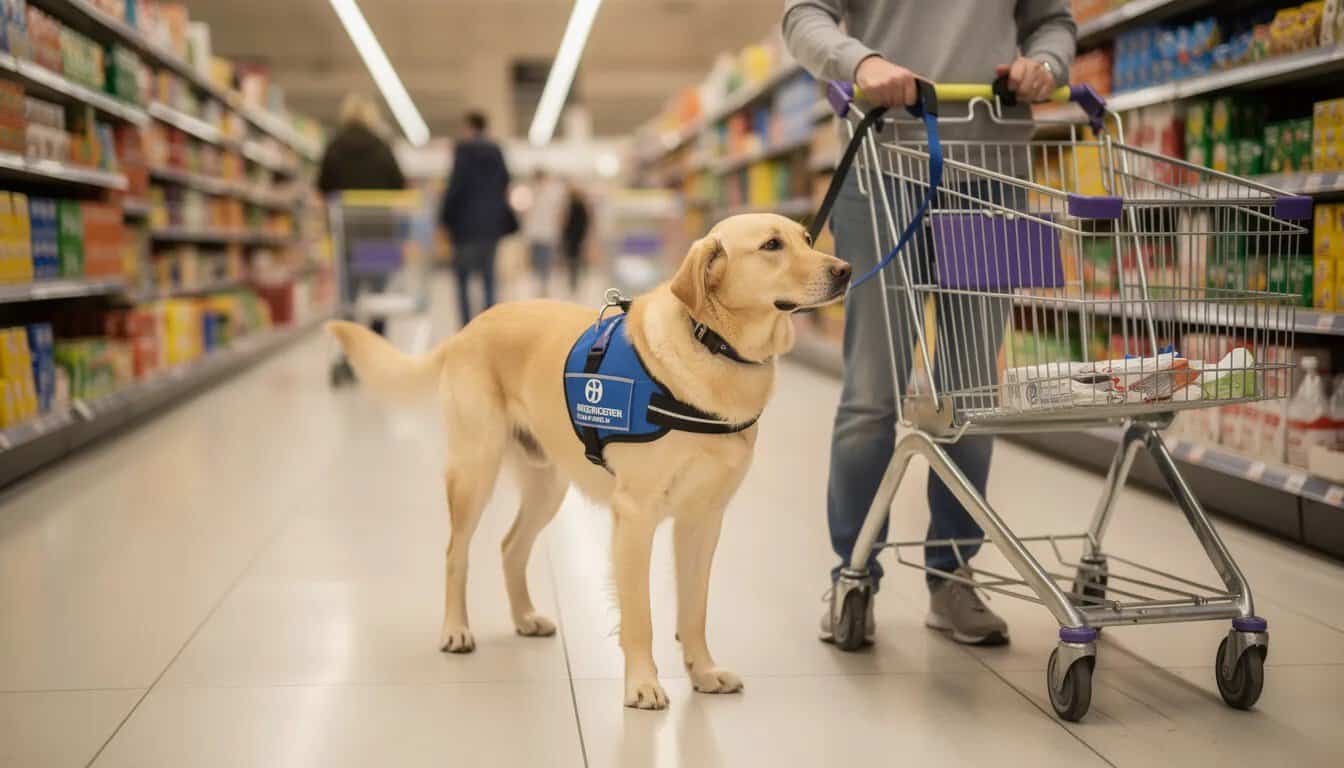
With basics established, the team ventures into real-world settings: parks, big-box stores, medical offices, and coffee shops. The veteran begins practicing customized PTSD tasks like blocking (the dog positioning itself between the veteran and approaching people), orbiting (circling to create a safe perimeter), and deep pressure therapy (applying calming weight during anxiety). The dog learns to perform these tasks on cue and, eventually, to recognize early warning signs and respond proactively.
Month 5-6: Refinement and Graduation
The final phase sharpens reliability under distraction. The team practices in crowds, around loud noises, and during unexpected events. Trainers use evaluation checklists to assess readiness, and the veteran and dog work toward certification or graduation milestones. By the end, t
he team is ready to function independently in daily life.
This timeline gives veterans a clear picture of what their own training journey might look like across weeks and seasons, from the first nervous meeting to the confident partnership that emerges.
Comprehensive Support Beyond Basic Training
Graduation day isn’t the finish line. It’s a starting point.
Veterans need more than commands and cues. They need ongoing community, mental health support, and follow-up for the life of the dog. Reputable programs understand this and build lifetime support into their model.
After the initial training cycle, most organizations offer:
- Refresh training sessions to sharpen skills
- Re-certification evaluations
- Phone or video support for questions and challenges
- Peer meetups and community events
- Access to professional trainers for troubleshooting
Many veterans use their training experience as a bridge to other forms of recovery. The routine of classes leads to keeping VA appointments. The confidence gained with a dog opens doors to counseling, support groups, and eventually work or school.
A strong support system also helps the team adjust to major life changes: moving to a new city, returning to employment, or managing the dog’s aging and eventual retirement years. Comprehensive support reduces the risk of dropout and helps sustain the dog’s skills for eight to ten working years of partnership.
Why It Works: The Veteran-Dog Bond
What thousands of veterans have reported since the early 2000s now has growing research to back it up. The human animal bond isn’t just emotional. It’s physiological.
Studies show that consistent interaction with a service dog lowers heart rate, decreases cortisol (the stress hormone), and increases oxytocin (the bonding hormone). These changes aren’t minor. For veterans whose nervous systems have been stuck in fight-or-flight mode for years, a calm, attentive dog can help rewire the body’s stress response.
Because veterans do much of the hands-on training, their dogs learn personal cues that no program could teach in advance. The dog notices when their handler’s breathing changes, when they start pacing, or when their fidgeting signals the early stages of a flashback. This customization makes a veteran-trained service dog extremely tuned in to their specific person.
The result is a dog who moves in front to create space before the veteran even asks, who leans in for deep pressure therapy at the first signs of anxiety, who nudges their handler toward the door when a situation becomes overwhelming. The dog doesn’t just follow commands. The dog understands.
Beyond the physiological, there are mental and social benefits that ripple outward:
- Renewed sense of purpose and mission
- Reduced isolation and loneliness
- Improved sleep quality
- Greater willingness to attend public events, family gatherings, and peer meetings
- Restored confidence in one’s own ability to function in the world
Requirements and Eligibility for Veteran Service Dog Training
Each nonprofit or training center sets its own requirements, but common eligibility guidelines appear across most U.S. veteran-focused programs.
Typical criteria include:
- Honorable or general discharge from military service
- Medical diagnosis of PTSD, TBI, or related mental health condition
- Current care with a licensed mental health provider or VA clinic
- Residence within driving distance of training classes for several months
- Commitment to weekly group or individual training sessions
Some organizations provide a dog from approved shelters or breeders. Others allow veterans to apply with their own dog, provided it meets temperament, health, and age standards set by the program.
Before You Apply: A Quick Checklist
Gather these items to streamline your application:
- DD-214 or other military service record
- Medical documentation confirming diagnosis
- Proof of residence (utility bill, lease, etc.)
- Basic lifestyle information (living situation, other pets, family members)
- Contact information for your current mental health provider
Being prepared with this documentation helps programs assess your eligibility quickly and moves you forward in the process.
Life After Graduation: Independence With a Service Dog
Graduation marks the beginning of a new chapter, not the end of the story.
Everyday tasks that once felt impossible become manageable. Grocery shopping without panic. Taking kids to school events. Flying on an airplane for a family visit. Sitting through a college lecture with the dog settled under the desk. These moments, small to some, are transformative for veterans who spent years avoiding them.
Many graduates report reduced need for certain medications. Sleep quality improves. Employment becomes realistic again, whether returning to a previous career or starting fresh. The dog doesn’t just help with symptoms. The dog helps rebuild a life.
Most programs encourage graduates to attend periodic refreshers, community events, and annual re-evaluations. Staying connected keeps skills sharp and maintains the bond between veteran and dog. It also provides a support network of other graduates who understand the journey.
Consider a veteran like Sarah, a former Navy corpsman who graduated from her training program in 2023. Within a year, she reconnected with her sister, enrolled in a nursing assistant program, and started volunteering at a local animal shelter. Her dog, a rescued Labrador named Bear, goes everywhere with her. She says he’s not just a service dog. He’s her lifeline.
Service Dogs for Veterans in Florida and Beyond
Veteran service dog programs now operate in most regions of the United States, with strong networks in Florida, th e Southeast, California, Oregon, Washington, and beyond.
Florida has become a hub for assistance dog organizations, research, and veteran-serving nonprofits. The warm weather allows year-round training, and a large veteran population creates strong community support. For veterans in Florida, local programs offer the advantage of nearby training sites, reduced travel, and access to ongoing care.
Before applying, it helps to understand the legal distinctions between different types of dogs:
| Type | Definition | Access Rights |
|---|---|---|
| Service Dog | Individually trained to perform specific tasks for a person with a disability | Full public access under ADA |
| Therapy Dog | Trained to provide comfort in settings like hospitals or schools | No public access rights |
| Emotional Support Animal | Provides companionship without formal task training | Housing and some travel protections only |
Only service dogs have full public access rights under the Americans with Disabilities Act. If you’re searching for a program in 2024 and beyond, look specifically for organizations that train dogs to perform disability-specific tasks and that follow the standards set by Assistance Dogs International (ADI) or equivalent accrediting bodies.
A properly trained service dog can accompany a veteran on trips throughout Florida and across state lines, improving access to care, family, recreation, and new opportunities wherever life leads.
Real Veterans. Real Training Stories
The statistics matter, but the stories bring them to life. Here are glimpses of what this journey looks like for real people.
Mark, U.S. Marine Corps Veteran, Jacksonville, Florida
Mark served two tours in Iraq and came home with PTSD that wouldn’t let him sleep more than two or three hours a night. His wife was exhausted, and his teenage sons had learned to tiptoe around his unpredictable moods. When he started training with Rex, a rescued German Shepherd mix, everything began to shift. Rex learned nightmare interruption, waking Mark with a persistent nudge before the worst moments hit. Within six months, Mark was sleeping five to six hours a night. At graduation, his wife cried harder than he did.
David, U.S. Army Veteran, Tampa, Florida
After a roadside bomb in Afghanistan, David lived with a traumatic brain injury that made balance difficult and concentration nearly impossible. Crowds overwhelmed him, and he’d lose track of conversations mid-sentence. His service dog, Maggie, learned to provide grounding during confusion, steady him when he wobbled, and retrieve dropped items like keys and his medication bottle. David says Maggie gives him the confidence to leave the house without worrying about falling or forgetting where he parked.
Angela, U.S. Air Force Veteran, Orlando, Florida
Angela’s service-connected injuries weren’t visible to anyone who passed her on the street. Military sexual trauma left her unable to tolerate crowded spaces or unexpected touch. For years, she avoided malls, concerts, and even busy restaurants. Her service dog, Luna, learned to orbit Angela in public, creating a physical buffer that keeps strangers at arm’s length. Luna also performs deep pressure therapy during panic attacks, lying across Angela’s lap until her breathing slows. For the first time in a decade, Angela went to a friend’s wedding last spring. She danced.
Leading the Way: Choosing a Reputable Veteran Service Dog Program
Not all organizations using the words “service dog” online are equal. Veterans deserve programs that meet high standards for training, animal welfare, and ongoing support.
Signs of a reputable program include:
- Transparent application process with clear timelines
- Written training standards and task lists
- Health and temperament testing for all dogs
- Professional trainers with credentials and experience
- Ongoing support after graduation (refreshers, phone consultations, community events)
- Clear communication about wait times, costs, and what is or isn’t covered
Trustworthy programs are upfront about expenses. Many provide dogs and training at no cost to the veteran, thanks to donors and community support. Others may require the veteran to cover veterinary care or equipment needed for the dog.
Questions to Ask Before You Apply
- How long has the organization been operating, and how many teams have they graduated?
- What is the typical wait time from application to placement?
- What tasks will my dog be trained to perform?
- What happens if my dog can’t complete training or needs to retire?
- What ongoing support do you offer after graduation?
Asking these questions helps you advocate for yourself and find a program that meets your needs.
How You Can Support Veterans Training Service Dogs
If you’re a civilian, family member, or community member looking to help, there are many ways to make a difference.
Ways to Support:
- Financial donations: Cover costs like veterinary care, training space, professional trainers’ time, and equipment. Training a single team can cost tens of thousands of dollars.
- Sponsor a dog: Some programs allow donors to sponsor a specific dog’s journey from rescue to graduation.
- Volunteer: Help with training sessions, administrative tasks, or community outreach events.
- Foster puppies or young dogs: Provide a loving home during early socialization phases.
- Share accurate information: Educate friends and family about the difference between service dogs and emotional support animals.
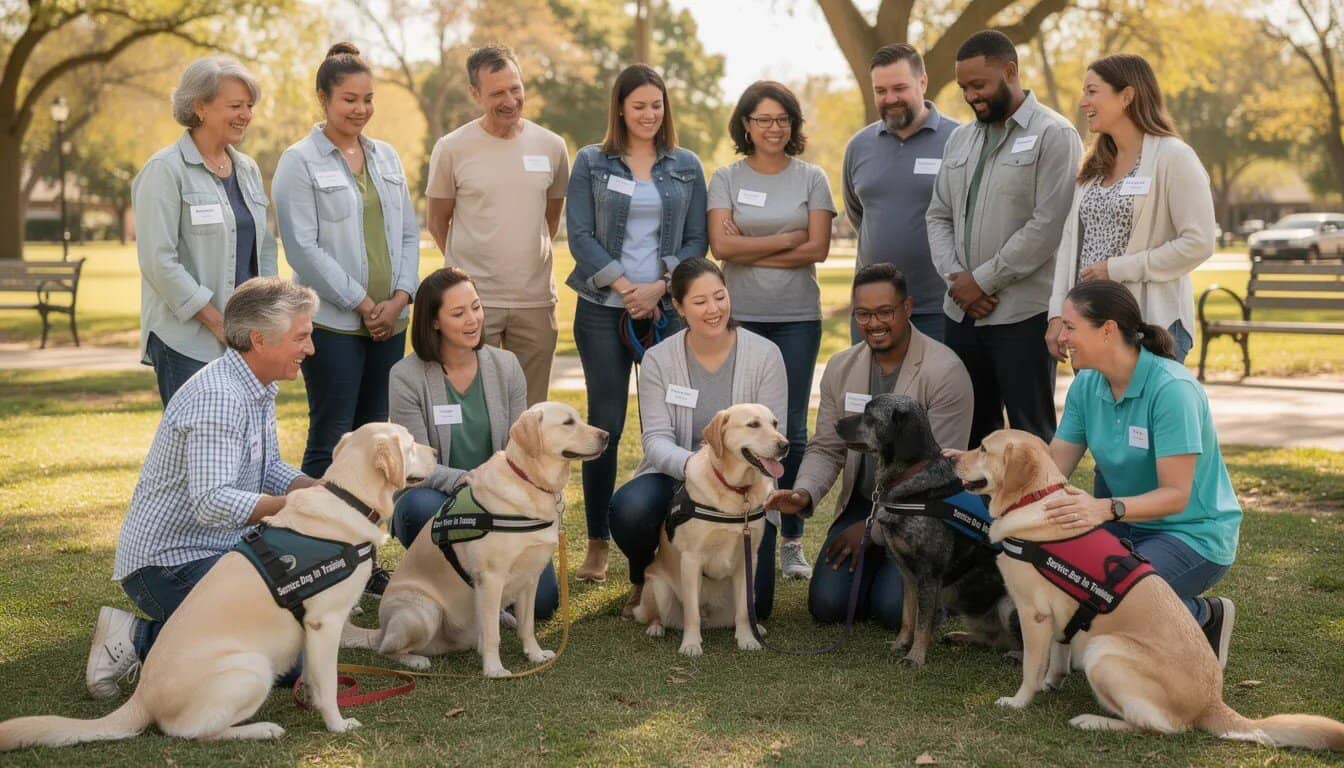
Local businesses in Florida and other states can also contribute by welcoming service dog training teams for real-world practice. Allowing a veteran and their dog-in-training to practice in your store, office, or restaurant helps prepare the team for independent life.
Advocacy matters too. Understanding and sharing information about service dog access rights under the ADA helps protect veterans and their dogs in public places. When you see a service dog team, give them space and respect. If someone challenges a veteran’s right to be there with their dog, speaking up can make all the difference.
About Genesis Assistance Dogs, Inc.
For families in Florida seeking a trusted partner in the assistance dog journey, Genesis Assistance Dogs, Inc. stands ready to help.
Our Mission: To provide ability and independence to transform the lives of people with disabilities through the training and placement of highly skilled assistance dogs in Florida for children and adults.
Our Vision: For people with disabilities to realize their full potential through the dedication, service, and companionship of a highly skilled assistance dog.
While many examples in this article focus on veterans training service dogs, Genesis Assistance Dogs, Inc. serves a broader disability community. We work with children and adults facing mobility challenges, medical needs, and other conditions where a highly trained assistance dog can restore freedom and independence.
Our team is committed to matching each applicant with a dog suited to their specific needs, providing thorough training, and offering ongoing support for the life of the partnership. We believe in the power of the human animal bond to create lasting change.
Contact Genesis Assistance Dogs, Inc.:
- Phone: (561) 329-0277
- Email: info@genesisassistancedogsinc.org
- Service Area: Florida
Whether you’re a veteran exploring your next steps, a family member seeking resources, or a community member looking to join our mission as a donor or volunteer, we welcome your message. The path to independence and hope begins with a single connection.
Frequently Asked Questions
How much does it cost a veteran to get a service dog?
Many nonprofit programs, including veteran-focused organizations, provide dogs and training at no cost to the veteran. This is possible thanks to donors, grants, and community support. However, veterans should ask about any expenses they might need to cover, such as veterinary care, food, or equipment like a vest or leash. Programs funded entirely by donations often have longer wait lists, so planning ahead is essential.
How many hours a week will I spend training my service dog?
Expect to invest several formal training hours per week, typically two to four hours in group or individual sessions with a professional trainer. On top of that, daily practice at home is essential, usually 15 to 30 minutes of reinforcing commands and tasks. The commitment is real, but most veterans find the structure and routine beneficial for their own recovery.
Can I apply if I don’t live in Florida?
It depends on the program. Some organizations, like Genesis Assistance Dogs, Inc., serve applicants within Florida. Others accept veterans from across the United States. When researching programs, check each organization’s geographic eligibility guidelines. If you’re outside a program’s service area, ask whether they can recommend a partner organization closer to you.
Can my service dog live with my family and other pets?
Yes, most service dogs live at home with their veteran’s family. However, the dog needs a stable routine, clear household rules, and slow, supervised introductions to other animals. Service dogs should not be treated as typical family pets during working hours, as this can confuse their training. A reputable program will guide you on integrating your service dog into your home life successfully.
What happens if my service dog gets sick or needs to retire?
Reputable programs offer lifetime support, which includes guidance for veterinary care and planning for retirement. When a service dog can no longer work due to age or health, the veteran may have the option to keep the dog as a pet while receiving a successor dog. Ask your program about their policies on dog retirement, medical emergencies, and successor placement before you apply.